
Building Regulations for Chimney Breast Removal
You’ve found a house in Lewisham, Bromley or Southwark. The chimney breast has already gone, or you want to remove it to gain space. On paper it looks simple. In reality, it’s one of the easiest ways to create a structural problem, a neighbour dispute and a nasty headache when you come to sell.
Here’s the blunt version. Building regulations for chimney breast removal are not optional. This is structural work. If the chimney is on a shared wall, the Party Wall etc. Act 1996 usually comes into play as well. Miss either of those and you can end up with unsafe support, failed paperwork and a buyer’s surveyor raising red flags later.
Table of Contents
- Do You Need Permission to Remove a Chimney Breast?
- Complying with Building Regulations
- Structural Support and The Engineer's Role
- Navigating The Party Wall Act
- Common Problems and Uncertified Removals
- A Step-by-Step Compliance Checklist
- Frequently Asked Questions
Do You Need Permission to Remove a Chimney Breast?
Yes, in most cases you do.
If you’re removing a chimney breast in a Victorian terrace in Forest Hill or an Edwardian semi in Bromley, you’re not just altering a wall finish. You’re changing part of the building’s structure. That means formal approval is usually needed before the work starts, not after a builder has already opened the wall.
There are two separate issues to deal with:
- Building Regulations approval: this deals with structural safety and related compliance.
- Party Wall procedure: this applies if the chimney is built into a shared wall with the adjoining owner.
If you’re still hazy on what formal sign-off involves, this plain-English guide to Building Control approval is worth reading before you touch the job.
Practical rule: If the chimney breast is staying in part, the weight above still has to go somewhere. Brickwork doesn’t suspend itself by goodwill.
People often ask if a small removal downstairs is different from taking out a full chimney. The answer is that the legal and structural thinking starts in the same place. Someone has to prove the remaining masonry is safely supported.
If you’re buying rather than altering, this is exactly the sort of issue that should influence the survey you choose. A useful starting point is which RICS survey level you actually need, because a more detailed survey is often the right call where chimney alterations are suspected.
Complying with Building Regulations
Why this work falls under Building Regulations
Building Regulations approval is required because chimney breast removal changes how the building carries load. In London homes, that point gets missed constantly, especially in older terraces and converted flats where previous owners have already removed part of the breast without proper sign-off.
Building control is checking whether the altered structure will remain safe, whether the support detail matches the design, and whether related work has been dealt with properly. That includes issues owners often overlook, such as making good the floor where a hearth has been removed and venting or capping off a redundant flue so you do not create a damp problem inside the stack.
If I find an old chimney alteration during a survey and there is no approval paperwork, it becomes a sale problem fast. Buyers get nervous. Solicitors raise enquiries. Lenders start asking questions.
For flats, approval under Building Regulations does not remove the need to deal with the shared-wall position properly. If the breast forms part of a party wall, read Navigating London's Party Wall Act 1996 before work starts, not after the builder is booked.
Full Plans or Building Notice
You will usually be offered two routes:
| Route | What it means | My view |
|---|---|---|
| Full Plans application | Drawings and structural information are submitted before work starts | Use this for chimney breast removal |
| Building Notice | The work is notified with less detail up front and inspected as it progresses | Poor choice for structural alteration |
Use the Full Plans route.
It gives you a proper record of what was proposed, what was approved, and what should have been built. That matters on site, because the builder is working from an agreed design rather than making decisions as the job unfolds. It matters even more later, because completion paperwork is what a buyer and their solicitor will want to see when the property is sold.
A Building Notice can work for minor jobs. Chimney breast removal is not one of them. In London, where neighbouring structures, altered layouts and historic shortcuts are common, vague paperwork causes avoidable trouble.
A quick explainer can help if you want to see the process discussed visually:
Structural Support and The Engineer's Role
Support design decides whether this job is safe or reckless. Builders can remove plaster and brick quickly. Holding up the masonry left behind is the part that matters.
What is being supported
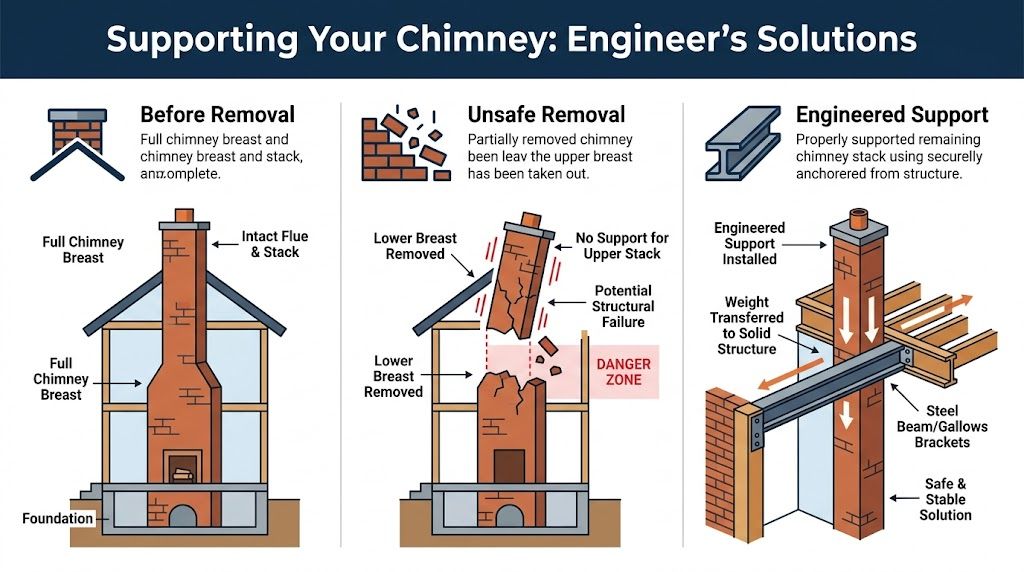
A chimney breast often supports more than the visible breast itself. In many London houses and converted flats, the remaining masonry above includes sections running through upper floors and the stack at roof level. Remove the lower breast and that weight must be carried by a properly designed alternative support.
That means calculations, drawings and a clear load path. Nothing should be left to site guesswork. If the support detail was improvised by a builder, you have a problem.
You also need to understand what remains. I regularly inspect London properties where the ground floor breast has gone, the first floor breast has partly gone, and the stack is still perched above with no clear evidence of how it is supported. Those are the jobs that derail sales, because nobody can show what was designed, what was approved, or what was built.
If there are no calculations, no approved drawings and no completion paperwork, assume nothing. A chimney stack still standing is not proof that the alteration was done properly.
The other point owners miss is balance. Support has to deal with the load in the right position. If the retained masonry is offset or poorly supported, the weight does not travel straight down through the structure. That is how you end up with rotation, cracking and, in the worst cases, failure.
Gallows brackets or steel beam
These are the two support methods you will hear about most often.
- Gallows brackets: steel brackets fixed into the wall to support the remaining chimney structure.
- RSJs or steel beams: a beam installed to carry the load and spread it more reliably into suitable bearings.
My advice is simple. Do not assume gallows brackets will be accepted, especially in London. In terraces, semis and converted flats, local authority building control officers and engineers often take a harder line because wall condition, shared structures and past alterations are rarely straightforward. A steel beam is more disruptive to install, but it is often the safer and more defensible solution.
Gallows brackets tend to cause the arguments. They rely heavily on the wall being suitable, the geometry working, and the remaining load being acceptable. In older London stock, those assumptions are exactly what need checking, not glossing over. If the chimney is on a party wall in a flat conversion, expect even more scrutiny.
Here is the practical comparison:
| Support option | Typical attitude from authorities | Main issue |
|---|---|---|
| Gallows brackets | Sometimes accepted, often examined closely | Entirely dependent on wall condition, layout and engineer's design |
| Steel beam / RSJ | More commonly accepted | More opening up, more cost, but usually easier to justify structurally |
The engineer's role is not a paperwork exercise. A competent structural engineer works out the load, checks the wall and bearings, specifies the steel or bracket arrangement, and gives Building Control something they can approve. If you are not sure who should be inspecting this kind of work before you buy, or after you discover an old removal during a survey, this guide on choosing a building surveyor in London without wasting time or money is a sensible place to start.
From a surveyor's point of view, undocumented chimney breast removal is one of the clearest warning signs in a London property. I flag it because the risk is real, the remedial work is expensive, and buyers, lenders and solicitors do not overlook it once it comes to light.
Navigating The Party Wall Act
Most London chimney breasts don’t exist in isolation. In a terrace or semi-detached house, the chimney structure is often built into a party wall shared with the adjoining property. That means your work affects more than your side of the plaster.
When the Act applies
The Party Wall etc. Act 1996 requires notice to be served at least two months before work starts on a shared chimney, as explained in this Party Wall guide. Ignore that and you can face injunctions. The same source notes that legal fees can escalate to £5,000-£15,000 if matters turn contentious.
That’s why informal chats over the garden fence are not enough. A friendly neighbour today can become a difficult one the moment cracking appears on their side, even if the crack was already there.
If you want a broader overview of the triggers and procedure, Navigating London's Party Wall Act 1996 is a sensible primer.
Converted flats are where people get caught out
This is the point many owners miss in places like Peckham, Camberwell, Islington and Southwark. In a converted house, there may be several legal interests tied to the same chimney line.
You may need to notify:
- The adjoining flat owner
- Another leaseholder in the same building
- The freeholder or landlord
In a two-flat conversion, that can mean three notices and agreements are needed, covering each flat owner and the freeholder, according to the verified guidance tied to converted buildings. That’s why chimney breast work in flats is usually more cumbersome than in a single freehold house.
Don’t let the builder tell you Party Wall paperwork is a formality. In converted flats it can be the part that causes the delay.
Leasehold owners need to be especially careful. Your lease may impose extra obligations, and failing to notify the landlord can create problems with insurance and later sale enquiries.
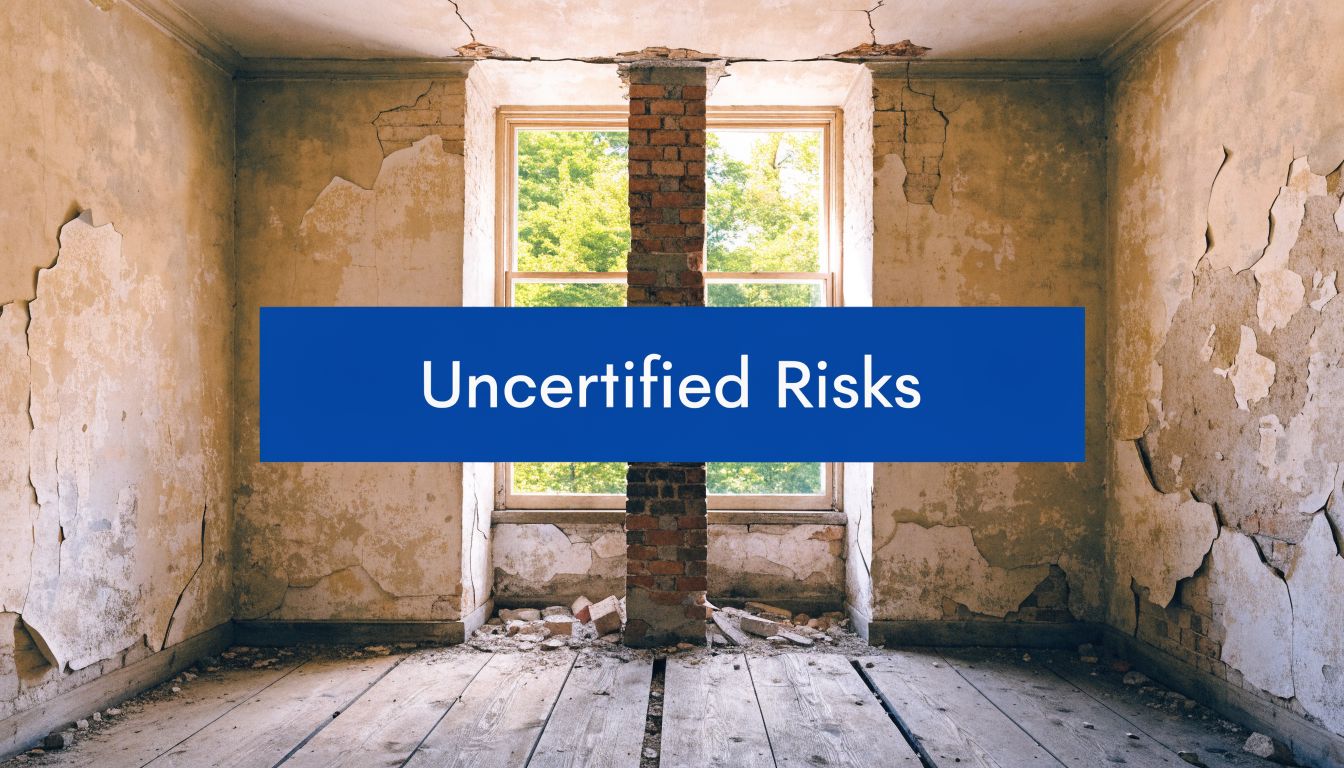
Common Problems and Uncertified Removals
The cases that cause the most grief are rarely the planned ones. They’re the old removals discovered halfway through a purchase, usually in Victorian and Edwardian housing where fireplaces were stripped out years ago and nobody kept the paperwork.
The missing certificate problem
A buyer commissions a survey. The surveyor spots a missing chimney breast, asks for the calculations and completion certificate and gets silence back. Then the transaction slows down.
Retrospective approval is possible in some cases, but it is not guaranteed. Verified guidance on retrospective approval for old chimney removals states that the process can cost £500-£1,500 in council fees plus £800-£2,000 for a structural engineer’s report, with a high risk of rejection if support is found to be inadequate, as discussed in this retrospective building regulations discussion.
That is why “it’s stood there for years” doesn’t solve the sale problem. Buyers, valuers and lenders still want evidence.
Defects that keep turning up
The structural support is the headline issue, but it isn’t the only one. I keep seeing the same practical mistakes:
- No proper flue ventilation: the stack is capped badly or sealed without ventilation, then damp appears in the breast remnant or loft space.
- Poor support to surrounding structure: hearths and associated timbers are removed, but no proper making-good is done to floor support.
- Shared flue confusion: one owner alters a chimney without understanding that another flue in the stack may still matter to the neighbouring property.
- Patch-and-plaster cover-ups: cosmetic finishes hide cracking long enough to get a property listed, but not long enough to get it through a careful survey.
A neat plaster finish tells you nothing about what is holding the masonry above.
A proper inspection proves invaluable. A Level 3 Building Survey is often the right choice where chimney alterations, older construction and hidden structural work are part of the picture. It won’t replace opening up, but it will tell you where the risk sits and what evidence is missing.
A Step-by-Step Compliance Checklist
If you’re planning chimney breast removal, keep the process simple and disciplined.
- Instruct a structural engineer first. Get calculations and drawings before any builder starts pricing shortcuts.
- Check whether the chimney is shared. In terraces, semis and many conversions, it usually is.
- Serve Party Wall notices in good time. Leave enough time for responses and any surveyor appointments.
- Submit a Full Plans application. For this type of structural work, that is the sensible route.
- Wait for approval. Starting early to “save time” usually creates the mess.
- Use a competent builder who will follow the engineer’s design. The cheapest quote is often the one missing the structural reality.
- Arrange building control inspections at the right stages. Don’t leave sign-off to chance at the end.
- Get the final completion certificate and keep it safe. This document matters when you sell.
A short checklist for your file helps:
- Engineer’s calculations and drawings
- Party Wall notices and any awards
- Building control approval
- Final completion certificate
If that paperwork is missing during a sale or purchase, the issue needs investigating properly, not brushed aside. That’s the sort of defect and document trail an independent surveyor should be checking. If you need that level of clear advice, Corinthian Surveyors London LTD is an independent RICS-regulated practice in Forest Hill, led by Clive Thompson MRICS and CABE, and can be reached on 0800 00 16 422.
Frequently Asked Questions
How much does chimney breast removal approval cost?
The exact building work cost depends on the property and design, so I won’t pretend there’s a standard figure. What can be said with confidence is that retrospective approval, if you’re trying to fix old uncertified work, can cost £500-£1,500 in council fees plus £800-£2,000 for a structural engineer’s report, based on the verified discussion linked earlier. Party Wall surveyor fees and the builder’s costs sit on top of that.
How long does the process take?
The one fixed timing you must respect is the two-month notice period under the Party Wall etc. Act 1996 for shared chimney work, as noted earlier. Beyond that, the programme depends on how quickly the engineer prepares calculations, how promptly building control reviews the application and whether any Party Wall dispute arises.
Can I remove a chimney breast myself?
No. This is not sensible DIY work. You are dealing with load-bearing masonry, legal notice requirements and formal sign-off. If you get it wrong, you don’t just ruin a wall. You can compromise the stack, the floor structure and the saleability of the property.
I’m buying a house and the chimney breast has already been removed. What should I do?
Ask for the structural calculations, building control approval and completion certificate straight away. If those documents can’t be produced, treat it as a live risk. A detailed survey is usually the right next step, and the practical questions people ask most often are covered on the Corinthian Surveyors FAQs page.
If you need an independent opinion before you buy, sell or alter a property, Corinthian Surveyors London LTD provides RICS survey and valuation advice across London. For older houses, flat conversions and properties with missing structural paperwork, that independent view matters.